
Company Core Values: A Conversation with Our CEO
Every company has values listed somewhere. Most companies let them collect dust. At Trelity, our ten core values are the reason we turned down a project when we had zero revenue coming in the door. And the client who watched us do it became one of our most trusted partners. We sat down with founder and CEO John Mickey and started with the most obvious question:
What are Trelity's core values, and why are they so important, not just culturally, but in how you actually run the business?
At Trelity we have ten core values and my wife and I created them as part of a years-long process to answer the question: How can people work at their best? For me personally I was deeply influenced by an office tour that I did at the Zappos.com headquarters in 2012. During the office tour they showed just how active a role their core values had in every aspect of their company. The person that did the tour said something to the effect that Las Vegas, where their company is headquartered, is one of the most diverse places in America and how do they have a really united team?
It's because they know that all their team members are similar at a very deep level because they are all in alignment with a common set of core values. That really resonated with me because I thought if that can be the case in Las Vegas, that could be the case anywhere in the world. Especially as we think about the multicultural team that we have primarily based in Izmir, Turkey.
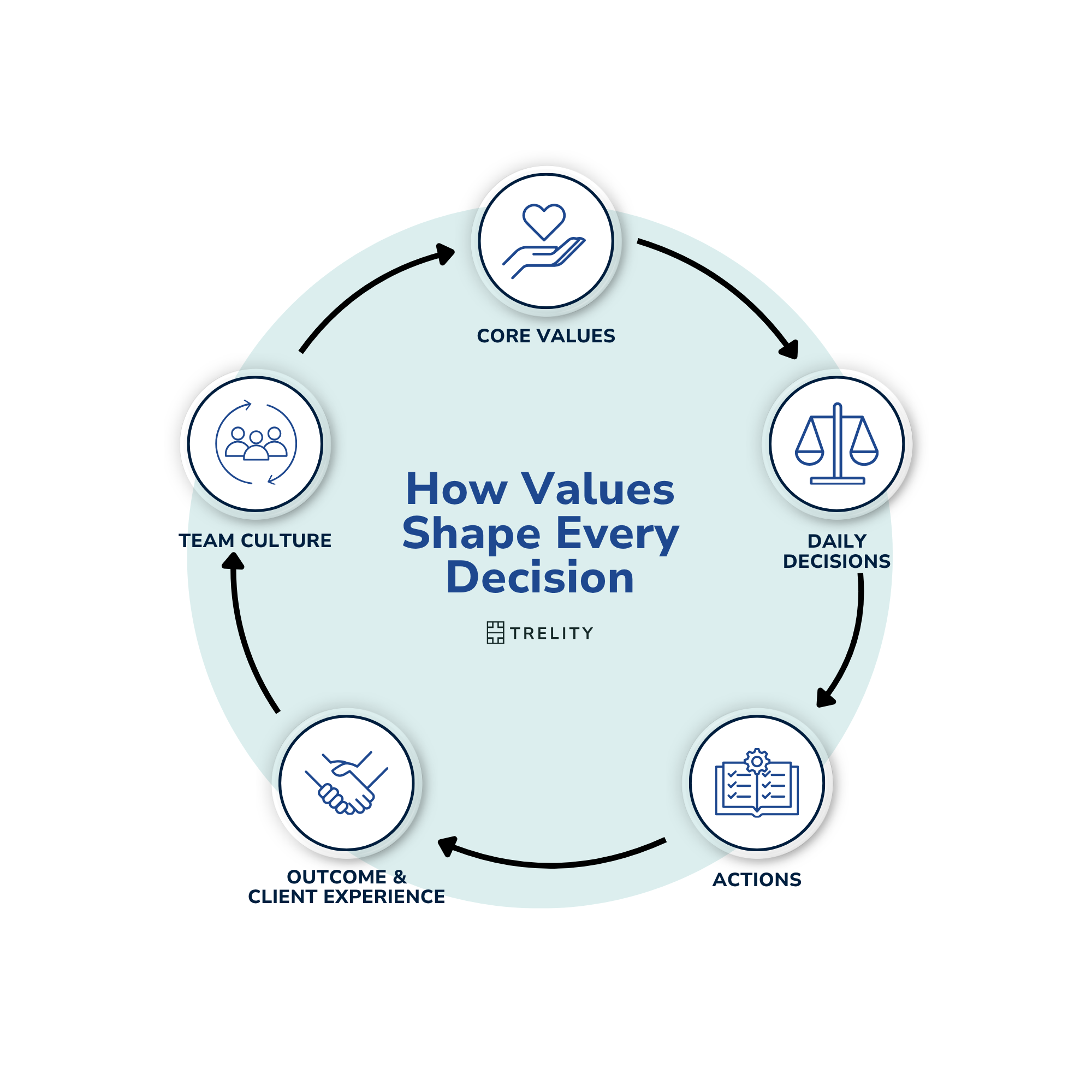
It wasn't until we started developing our 11-part core values training series and I worked with a PhD in psychology to look at some of the research that exists about the importance of company values and some of the benefits that any organization experiences when their team members' personal values align with the company or organizational values. Basically, across many dimensions the outcomes are exceedingly positive when the team member's personal values are in alignment with the organization's values. And it's important as an organization that these values are clear because every person in the company is going to make who knows how many decisions in a day. Often what is right or what is best can be unclear. We need an underlying principles-first approach to help guide the many, many decisions that are going to be made, for not only frontline team members but also the executive leaders. We are faced with many hard decisions, and of course complex decisions can be very nuanced. One of the things that we just have to try to ask ourselves is whether it's a big decision or a small decision. Is there anything that our values would have to say as we think about making this decision? Is there any guidance that they would help provide? This can help us zoom out and see the decision, the factors, and the outcomes in a different light.
How do those values drive who you target as a client, and how you show up at every stage, from first conversation to established partnership?
Now as we increasingly lean on AI, one of the things that we're able to do is have AI train on our values and identify when we're prospecting firms that show alignment based on what is present about their firm's values on their website to ours. We can actually prioritize working with a company or targeting a company based on that alignment. Ofcourse it's easy to have a list of values listed on the website and from firm to firm how much they're lived out can change drastically. Oftentimes if it's something they really takeseriously, it's actually pretty clear between their website and the personality that's shown on it and what you can find on social media and then just confirming that when you're actually talking with those people on the initial calls. It's not uncommon for people to mention that when they hear about our core values, they take their values seriously as well and that our organization's values are in alignment. We actually see that when that's the case and we mutually see that we take these things seriously, it actually kind of draws us towards wanting to work with each other.
Does Trelity have a defined process for evaluating client fit before onboarding, and what does that actually look like in practice?
Like any relationship things can seem like they're all going to be fine at the get-go. One of the things that we're particular about is being very upfront that our core values are very important to us and they drive our decision-making and how we find, train, and develop our team.
At what point in an early conversation do you start sensing whether there's a real values match, and what are you listening for?
Honestly a client mentioning anything about liking our values or saying that values are important for their company is a good marker that they're probably going to like working together. People that really don't care about it don't mention anything about it.
Probably the best sign is when a client speaks about their own company's values and actually can mention one or two of them and why they're important.
When you look at your best client relationships, what do they tend to have in common beyond the work itself?
Professional + Human Respect
Sometimes when American firms are working with global design support groups like ourselves, there can be the idea that they're better than people overseas. I always take the perspective that all humans are truly created equal but there's a lot of different culture, history, and education. With the right training and the right work environment we can really get the best out of people. On the client side when there is a good sense of professionalism and just in general human respect, things can really hum because people aren't looking at what's different about them. As long as they can communicate, there is the technical trust and the feedback is being given in a helpful way, and we can really overcome anything.
Transparent Communication
One of the things I probably dislike the most in communication is when people are trying to be nice. I like the idea of being kind but I've always gone with the idea that we need to speak the truth in love. I'm always interested in what is true about a situation. If our technical knowledge isn't enough, I want to know that. If we're having communication issues, I want to know that. If there is a training issue, we want to know that. All those things can only come out in a healthy way if communication is happening and people aren't afraid to share what they're really thinking.
Also working on projects is always a two-way street. There can be situations, and frequently when there are issues, a lot of times we haven't been given all of the materials or instruction or files or templates or families to get the job done well. I'd say probably one of the most frequent things that we get back from clients is, "Oh I forgot to give that to you."
As long as we can get all of the context and all of the files and have good kickoff calls to get the project off on the right start and then at least weekly calls, particularly for the beginning of programs and projects, I don't expect projects to go well if our teams aren't talking with one another. Yes teams chats are really helpful. Emails are super helpful. Everything being on Autodesk Forma. There is just a lot of ground that is covered. I think also when people are having the team's meetings with video on, they get to see the humanity in one another. They can get to know each other a little bit. They're learning about different cultural things, holidays that are going on, so on and so forth, and that just builds camaraderie and a sense that we really are partners in this.
Have you ever walked away from a client opportunity because the fit wasn't right, and how do you think about that decision?
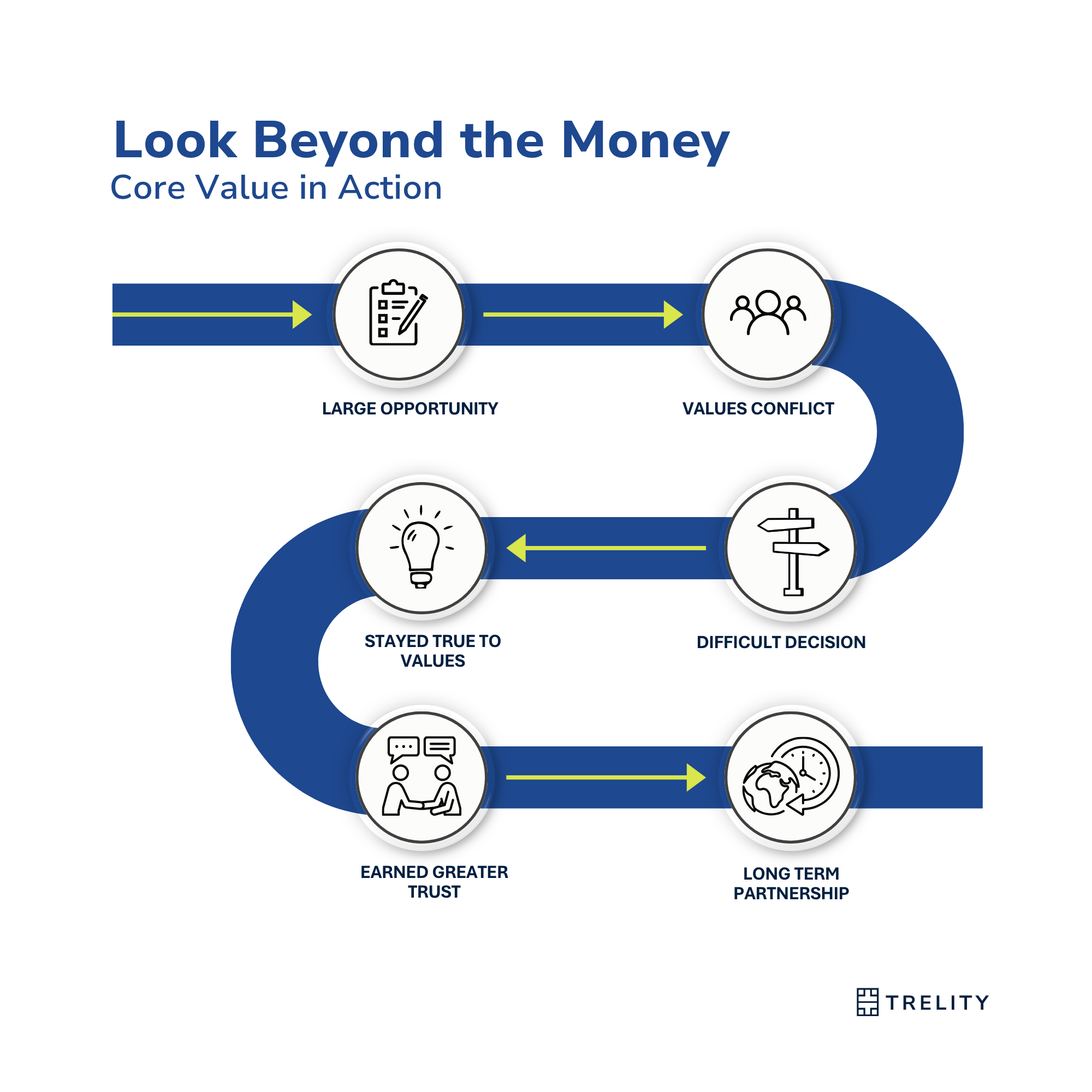
So one of the ways that our values have really played a role in what projects we might say no to is to look beyond the money. We've actually had a client come to our office in Izmir, Turkey. We did an activity as part of our fifth-year anniversary retreat where we shared stories about how we've lived out our values. This client brought up the idea or his story about a time that we lived out the value of "look beyond the money." He said, "Don't you remember, John? You all said no to X projects."
Well that project was the third largest marijuana growing facility in North America. And yes, I know that it could be used for medicinal purposes, this, that, or the other. But at the end of the day in our cultural context that has a very different meaning than in North America at this time and place in modern history.
I didn't want to send our team members home and have them share with their mom or dad or loved one what they were working on that day because it would not be understood well. It would not have been respectable in our context. So at that moment, this was pretty early on in our history.
We did not have any other projects to work on. If we did not do that project, we were completely empty. There was no revenue coming in the door. But we stuck to our values and that really made an impact with this client. He said, "You know what? I really respect the fact that you are open and transparent and honest with us and it shows that if you're honest with us in this, you're going to be honest with us when you don't have enough capacity or there's a problem going on." I really respect this and it will not affect our commercial relationship at all. We have done an amazing amount of work with that client and it shows that we can be ourselves and not worry. We want to work with clients that we don't have to worry about whether or not we can be ourselves. We're very clear about who we are and what we value and it helps other people know that from the very beginning. We share that. If values are really being lived out, they're going to show up in how decisions are made. Our clients should see them and how they really are brought to life. Even the idea that one of our clients can tell a story about how we've lived out our values is pretty remarkable and really encouraging.
What happens, operationally and relationally, when a firm pushes forward with a client that isn't truly aligned?
When we have a high degree of alignment with one of our clients on multiple levels (technically, relationally, communication, project volume), what I see is that we get in flow. Everybody talks about wanting to get in flow personally. Well it happens team to team as well.
What it feels like, and what our clients have described it as, is that we just feel like an extension of their team. They feel like they have a group of people that really care about them, their projects, and their success all the way around the world. They feel that way because it's true. We are wondering how they're doing. We're wondering are they satisfied. We're asking the question over and over: "Is there anything that we can do a little bit better? Is there anything that we're doing that bothers you?" We're living out our first value: serve everyone always. I think a great servant wants to know, "Is there anything else that you need?"
What does a well aligned partnership make possible that a misaligned one, even a functional one, never can?
When there's a lack of alignment, it shows itself in friction one way or another. Where efficiencies are lost or, I think, the biggest thing that I see lost is time. We can overcome:
miscommunication issues
pricing issues
misalignment with expected amount of effort required and actualized effort required
accounts receivable issues
When we have a deeper level of alignment and I also recognize that this comes with time.
We start with a new client and we're getting to know one another and we figure out what partnerships make sense. There have been one or two situations where it was just very clear, for a variety of reasons (probably most often related to really high expectations and a very low pricing expectation) that we just weren't in alignment. So rather than dancing around that, we much prefer to just talk and be real with one another. Make sure that if we need to shift anything around or take a step back, that we're doing that respectfully, with a good timeline and clearly.